After the introduction of Gandhi, by Professor Chaturvedi, lectures and seminars have based their focus on understanding the interworks of philosophical minds in history. During a class discussion a couple of weeks ago in Seminar, Professor Castillo rose a question linked to the ideologies of man and the ways in which it may be interpreted by those such as Gandhi.
“Are humans intrinsically good or bad?”

The question that echoed in our seminar room as we began discussing the intellect of Gandhi in the second half of winter quarter.
A short question, yes. But, also, a question that can be approached and debated in an infinite number of ways. As we first split into pairs, I was able to collect my thoughts and build on my conversation with my partner. Granted that we both were quick to agree that humans are naturally born good, the discussion we had as a class afterwards helped us understand the question at a deeper level—given alternative perspectives.
In his piece Hindi Swaraj, Gandhi extends the discussion on the state of England and India, and the ways in which people are impacted by civilization. Evidently, Gandhi does not imply that man is bad or good, which brings into debate which side he sways with this question.
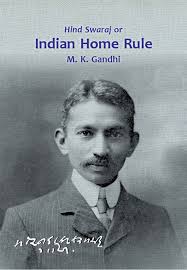
He addresses the question of whether man is inherently good or evil, stating that before now, man has taken part in actions that are consequently wrong. Moreover, he stands on the spectrum suggesting that the evils of civilizations and its influences are factors that may draw a man towards being inherently bad. The temptations of man and values they have promoted through society are means that may sway one’s morals. However, he counters the “issue” by offering a means in which people can resist the corruptions of man or become “soul force.”
“Soul force”, otherwise known as Satyagraha, is the idea of nonviolent resistance. A practice known as “passive resistance”, consisting of four pillars: Chastity, Poverty, Truth, and Fearlessness.
Gandhi’s method to achieving Satyagraha is covered through the four pillars, four distinct factors that will influence one’s path to a man’s journey towards passive resistance.

Moreover, the class discussion we had a few weeks prior to me writing this blog post sparked a lot of questions and hypotheticals. It was extremely enlightening to see the many standpoints on the question and the ways people were responding to one another in discussion. Ultimately, as the discussion got deeper and rooted into other works and topics we have be introduced to over the quarter, there came a point where there was no right or wrong to the question.
The question of good or bad is stuck in a grayspace, for the world is not necessarily just two drastic ends of a spectrum: black and white. And, the ways in which that was addressed in Seminar allows for a reflection on the questions being asked and how one is looking at the situation.

 Exploring Empire
It’s been such fun reading your blog, Michelle!
LikeLike