Empire and Its Ruins. Upon learning that the Humanities Core theme was organized around the theme of empire and its ruins, I was expecting lectures focused on analyzing the past – correlated to emperors, kingdoms, and territory. Yet, with the handful of readings we have digested for homework, my understanding of what an empire is and stands for has evidently changed.
So, what is an empire? According to Merriam-Webster, an empire is a major political unit having a territory of great extent or a number of territories or peoples under a single sovereign authority. This first definition gives reference to the “textbook” understanding of what an empire is, also what I initially thought the course was focused on. Under this definition, one may think of the Roman Empire, which had notable influences on western culture.
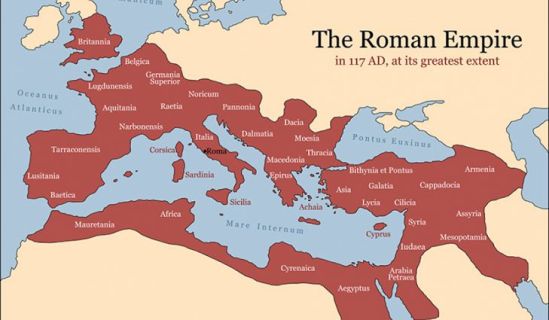
Rome, the empire’s capital city, exemplifies the extensive power and resource that the Romans had. In their time, the Roman Empire was able to spread their impact on subjects such architecture, language, literature, art, and science. At the height of Roman power, the empire consisted of roughly 65 million people, 21% of the world’s population during the time period. With such a large population, how were they able to run the empire smoothly for roughly 507 years? This is where the hierarchical structure comes into play. The order from emperors, at the forefront, all the way to the slaves at the base, illustrates a method that may have played a part in enabling their success as an empire.
On the other hand, with the well known expression, “the sun never sets on the British Empire”, the British share another characteristic of what it means to be an empire: its expansive nature. The empire’s ability to spread and conquer allows us to visualize the power they held over the world during the time. At its height, the empire was able to conquer 23.84% of the world, claiming British territory. In both scenarios, there is the overarching idea of power and control that is shared.
The idea of power and control can be transferred to our modern day description of empire. While the definition of what an empire is has evolved, many of the core concepts still apply. As noted by Oxford Dictionaries, empire can also be defined as a large commercial organization owned or controlled by one person or group.

Under the second definition, the overarching theme is still passed on, yet the idea of a ruler is replaced with corporations and major businesses. A modern day empire can be comprised of many different fields, whether it may be music, medicine, film, or etc. Moreover, an empire in modern terms references anything with a large sphere of influence. For example, food monopolies are a clear form of modern day empire, for brands such as Kellogg’s and General Mills control the cereal shelves vastly. Thus, even small everyday things such as cereal brands that we are exposed to on a daily basis are a product of empire.


It is true that the definition of empire has evolved from its origins. There could be an empire in gaming, oil, or sports. I talked about empire in the NBA in my first blog. While there is no formal definition of empire in the NBA, there is a consensus of what it means to be an empire in the sport of basketball. It includes having the best players on your team, having the biggest sponsorships, having the viewership, and of winning many championships especially in succession. We can see evolved defining of empire, but it is important to know there are unique ways to be an empire in something and it doesn’t always conform to the formal definition.
LikeLike
I really like your flow of ideas. I like how it starts off by discussing the Roman Empire, then moving on to the British empire, and then connecting it with this notion of a modern empire. I also like how you go into how there are different fields that could constitute what a modern empire is. For example, when you mention film, medicine, or even different cereal brands, this new way of looking at what empire is, is very eye opening.
LikeLike